38. Count and Say
The count-and-say sequence is a sequence of digit strings defined by the recursive formula:
countAndSay(1) = "1"countAndSay(n)is the way you would "say" the digit string fromcountAndSay(n-1), which is then converted into a different digit string.
To determine how you "say" a digit string, split it into the minimal number of groups so that each group is a contiguous section all of the same character. Then for each group, say the number of characters, then say the character. To convert the saying into a digit string, replace the counts with a number and concatenate every saying.
For example, the saying and conversion for digit string "3322251":
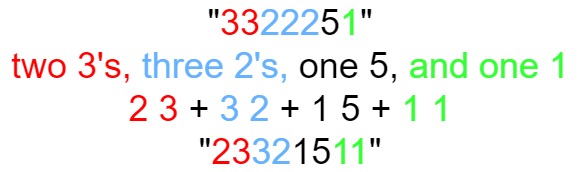
Given a positive integer n, return the nth term of the count-and-say sequence.
Example 1:
Input: n = 1
Output: "1"
Explanation: This is the base case.
Example 2:
Input: n = 4
Output: "1211"
Explanation:
countAndSay(1) = "1"
countAndSay(2) = say "1" = one 1 = "11"
countAndSay(3) = say "11" = two 1's = "21"
countAndSay(4) = say "21" = one 2 + one 1 = "12" + "11" = "1211"
Constraints:
1 <= n <= 30
Practice Here :
Solution :
#include <bits/stdc++.h>
class Solution {
public:
string say(string n)
{ string ans="";
int ct =1;
char c = n[0];
for(int i=1;i<n.length();i++)
{
if(n[i]!=c)
{
ans+=(ct+'0');
ans+=(c);
ct =1;
c = n[i];
}else {
ct++;
}
}
ans+=(ct+'0');
ans+=(c);
return ans;
}
string countAndSay(int n) {
vector<string> v;
v.push_back("0");
v.push_back("1");
for(int i=2;i<=n;i++)
{
v.push_back(say(v[i-1]));
}
return v[n];
}
};


No comments:
Post a Comment